
Crib Scoring Chart
Counting a cribbage hand quickly — “fifteen two, fifteen four, a pair is six…” — takes practice, and double runs and flush rules catch everyone out. Choose your four cards and the starter and this counter lists every scoring combination, then totals the hand. The chart below covers pegging, hand scoring and the famous impossible scores.
- Free to use
- No sign-up
- Runs in your browser
Cribbage hand counter
Cribbage Scoring Pack
Printable cribbage reference: hand scoring chart, pegging chart, common hands table and a scorecard for games to 121.
- Hand scoring chart (PDF)
- Pegging chart (PDF)
- Common hands (PDF/XLSX)
- Scorecard (PDF/DOCX/XLSX)
Formats: PDF, XLSX, DOCX. Instant download after payment (link valid 72 hours, up to 5 downloads). AI-assisted: the templates were drafted with AI help and reviewed and laid out before publishing.
$3.00 USD, one-time 4 files · about $0.75 each
- Instant download
- 7-day refund
- Secure checkout by Stripe
7-day money-back guarantee. Full refund within 7 days of purchase, even after you download.
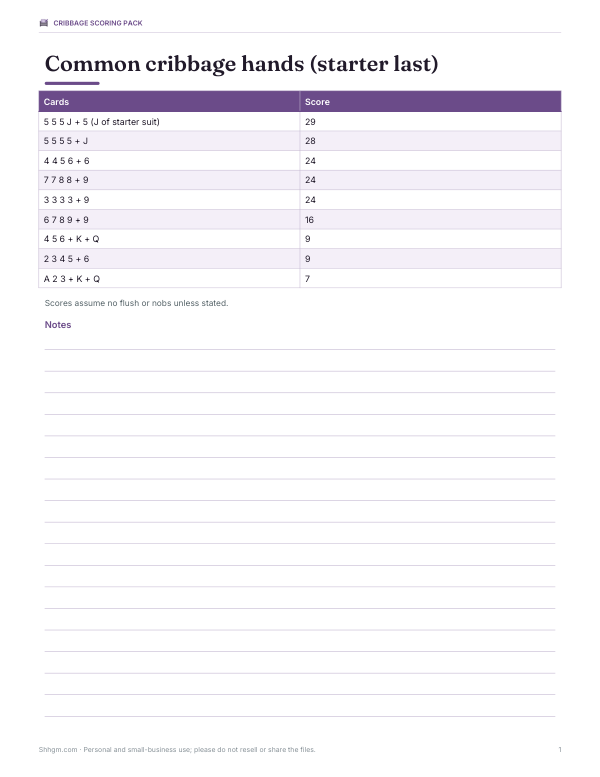
Free sample: Common Cribbage Hands (PDF, 64 KB)
Full refund within 7 days — see the refund policy and license.
Free printables
Single sheets you can print right now, no sign-up. The full pack adds every sheet in one download plus the editable files.
 Printable Cribbage Scorecard
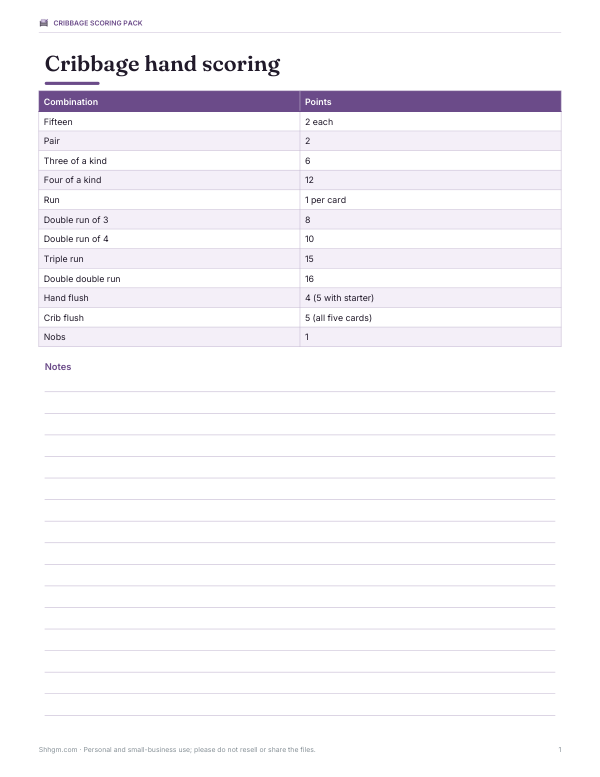
Hand scoring chart
| Combination | Points | Notes |
|---|---|---|
| Fifteen | 2 each | Any cards totalling 15 (face cards = 10, ace = 1) |
| Pair | 2 | Two cards of the same rank |
| Three of a kind (pair royal) | 6 | Counts as three pairs |
| Four of a kind (double pair royal) | 12 | Six pairs |
| Run of three / four / five | 3 / 4 / 5 | Consecutive ranks, any suits; ace is low only |
| Double run of three | 8 | E.g. 4-5-5-6: two runs (6) plus a pair (2) |
| Double run of four | 10 | Two runs of four (8) plus a pair (2) |
| Triple run | 15 | Three runs of three (9) plus three of a kind (6) |
| Double double run | 16 | Four runs of three (12) plus two pairs (4) |
| Flush (hand) | 4 or 5 | All four hand cards one suit; 5 if the starter matches |
| Flush (crib) | 5 | Only if all five cards, including the starter, are one suit |
| Nobs | 1 | Jack in hand of the same suit as the starter |
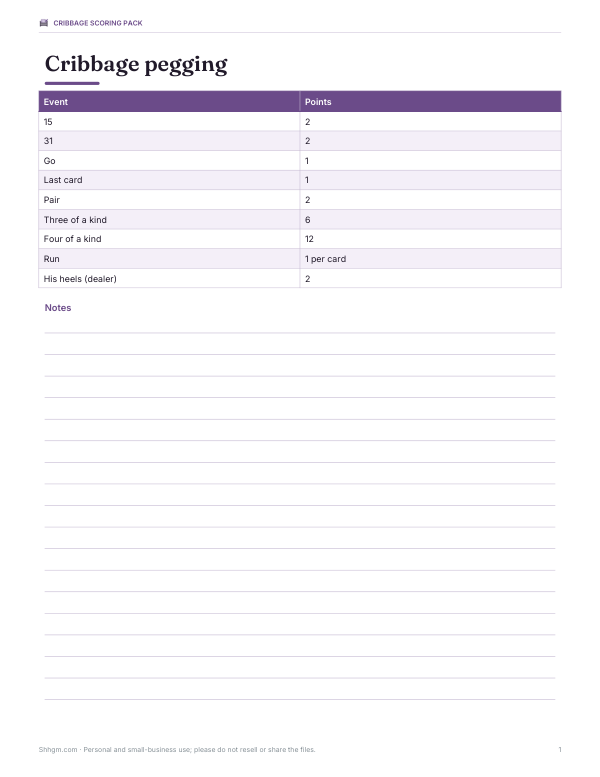
Pegging (the play)
| During play | Points |
|---|---|
| Reaching exactly 15 | 2 |
| Reaching exactly 31 | 2 |
| Go (opponent can’t play under 31) | 1 |
| Last card (not 31) | 1 |
| Pair | 2 |
| Three of a kind | 6 |
| Four of a kind | 12 |
| Run of 3 or more (in any order, unbroken) | 1 per card |
| His heels — starter is a jack (dealer) | 2 |
During the play, cards are laid one at a time and the running total may not go over 31. Runs in pegging count even if the cards were played out of order, as long as no other card interrupts them.
Order of counting after the play
- Non-dealer (pone) counts their hand first, using the starter as a fifth card.
- Dealer counts their hand.
- Dealer then counts the crib.
- The game is usually played to 121 points; the first to reach it wins immediately, even mid-count — which is why non-dealer counting first matters in close games.
Worked example: 5-5-J-10 with a 5 starter
The hand 5♥ 5♦ J♣ 10♠ with the 5♠ starter scores 20 by this counter. Each of the three fives makes fifteen with the jack and with the ten (six fifteens, 12 points), and the three fives together make fifteen (another 2), so fifteens total 14. The three fives are three of a kind (6), making 20. There are no runs or flush, but because the jack is a club and the starter a spade, there is no nobs — change the starter to the five of clubs and nobs adds 1, for 21. The famous 29 hand is three fives and the jack of the starter’s suit with the fourth five as the starter.
Impossible scores and the 29 hand
The maximum hand is 29: 5-5-5 and a jack in hand, with the fourth five of the jack’s suit as starter — eight fifteens (16), four of a kind (12) and nobs (1). Some totals can never be scored in a hand: 19, 25, 26 and 27. That’s why cribbage players jokingly say “nineteen” when a hand scores zero.
Common counting mistakes
- Forgetting the starter card is part of every hand and the crib.
- Missing fifteens made of three or four cards.
- Counting a double run as only one run.
- Claiming a four-card flush in the crib (it needs all five).
- Counting the “his heels” 2 as part of the dealer’s hand — it is pegged when the starter is cut.
Counting practice
Use the Random hand button to deal five cards, count the hand yourself, then compare with the counter’s breakdown. A few minutes a day builds speed quickly, and seeing each fifteen and run listed makes it clear which combinations you tend to miss. Try counting the same five cards as a hand and as a crib to see how the flush rule changes the score.
How to count quickly
- Count fifteens first, working systematically: pairs of cards, then threes, then fours.
- Then pairs, three of a kind and four of a kind.
- Then runs — remember double and triple runs.
- Then flush, then nobs.
- Say the running total aloud: “fifteen two, fifteen four, and a pair is six…”
Experienced players recognise common patterns instantly — a double run of three is always 8, a triple run always 15 — so learning those combinations speeds up every hand.
Choosing cards for the crib
When you deal, you discard two cards into your own crib, so you can throw cards that work together, such as a pair or two cards totalling five. When your opponent deals, avoid giving them fives and pairs, which score well in any crib. Keeping a balanced hand with fifteens and a run is usually worth more than keeping high cards.
Muggins
Some groups play “muggins”: if a player undercounts, the opponent can claim the missed points. It’s a good incentive to count carefully — and a good reason to use the counter while learning.
Privacy
The counter runs in your browser.
Frequently asked questions
How do you score fifteens in cribbage?
Every combination of cards totalling 15 scores 2 points.
What is the highest cribbage hand?
29 — three fives and the jack of the starter’s suit, with the fourth five cut.
Which scores are impossible in cribbage?
19, 25, 26 and 27.
Can you have a four-card flush in the crib?
No — the crib needs all five cards of one suit.
What is nobs?
One point for holding the jack of the same suit as the starter.
What is a double run?
A run with one rank doubled, such as 3-4-4-5 — two runs plus a pair, 8 points.
How do you count a 29 hand?
Eight fifteens (16), four of a kind (12) and nobs (1).